What does Swingbolt mean?
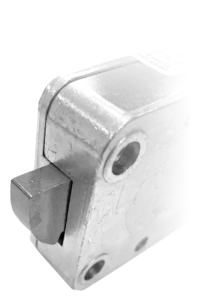
The Swingbolt, or Rotobolt lock, got its name from the bolt, which is mounted like a swinging lever. In the local language area, it is occasionally also referred to as a ‘swing latch’. This type of lock is probably the most important invention of designer Nick Gartner and has been technically improved by him repeatedly over the years. Most recently for the company NL Lock, in which an employee of Lock4Safe was also involved.
For the user of the lock, the most important feature is, of course, the simple operation.
To open: Enter the code and turn the safe handle…done.
To close: Turn the safe handle…and the safe is locked.
With locks like the Combogard or the SEKU lock, one must first turn the keypad to close or open. With a motorized lock, one has to wait until the motor has finished. Not to mention mechanical locks. All of this is eliminated with the Swingbolt. The safe and the lock rather act like a unit and are completely logical for the operator. Operational errors associated with the other methods are eliminated.
Function
Swingbolt locks lock unilaterally against the movement direction of the bolt mechanism. When the lock is unlocked (valid code), the safe’s bolt mechanism can push the lock bolt into the lock case, and the way is thus clear. When closing, the bolt mechanism is moved in the opposite direction and the spring-loaded lock bolt automatically jumps into the locking position and blocks the safe’s bolt mechanism. Reopening is then only possible again with a valid code.
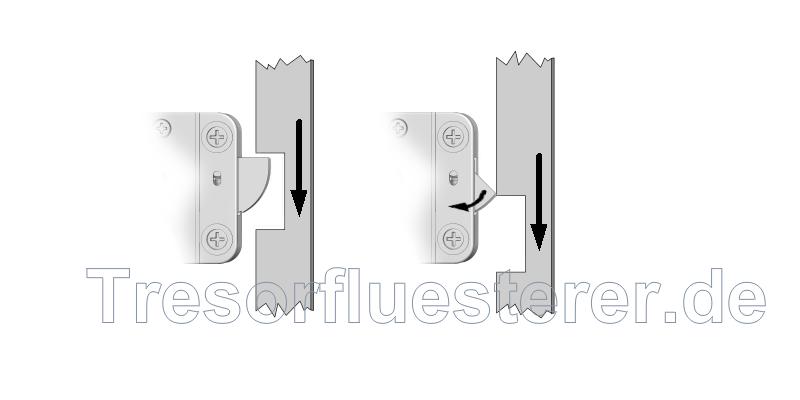
Fig.: Bolt movement when opening a Swingbolt lock
Why can’t the lock be pried open?
Since the bolt is designed like a lever, one would think that with enough force one could break the bolt lock inside the lock. One would think so, but the Swingbolt lock uses a brilliant trick so that this cannot happen. The rotation axis of the bolt is mounted to move. The bolt lock only needs to prevent the bolt from turning inward at the first moment. Instead, the force acts on the spring(s) of the rotation axis and shifts it so that the bolt hooks into the housing. From that moment on, the bolt lock is virtually load-free. In the development phase, various variants of plastic bolt locks were successfully tested. These also withstood all stress tests at both VdS and UL. The reason why it was finally made from metal is more of a psychological nature and prevents the idea that one could manipulate it using “maybe something with heat.”
The triumph of Swingbolt locks is also unstoppable in Germany
And that despite the miserable marketing of the manufacturers La Gard, NL Lock, and more recently Wittkopp and STUV. When customers are allowed to try the different locking variants, 9 out of 10 give preference to the Swingbolt. It is the easiest to operate, simple to install, and also very inexpensive.
So what prevents some German safe manufacturers from using the lock? Is it the attachment to tradition? Ignorance? Stupidity?
It is probably rather the lack of pressure from consumers. A multitude of safes are manufactured with bolt mechanisms that lock on both sides. These bolt mechanisms require a small adjustment because the Swingbolt, as described above, locks unilaterally. Safe manufacturers are only willing to do this if the customer says: